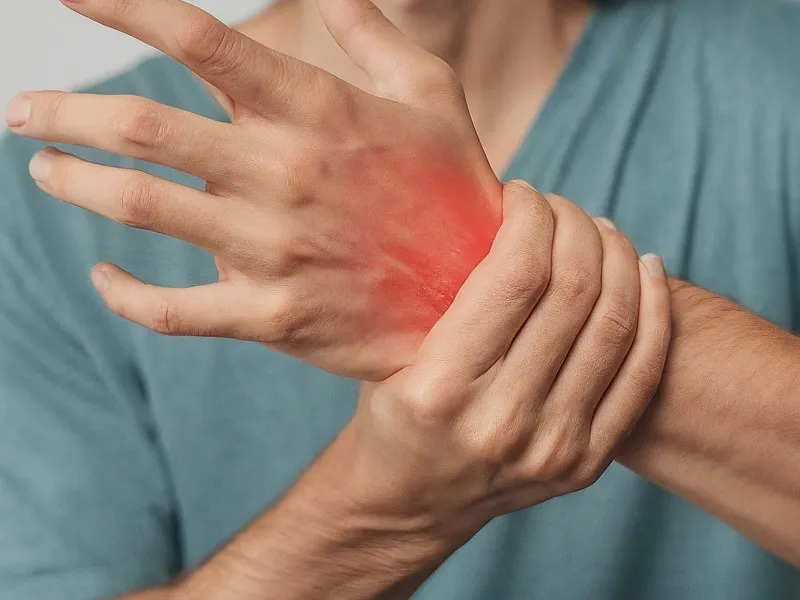
Wrist ligament injuries — particularly scapholunate tears — are frequently dismissed as sprains. Early specialist assessment prevents progression to arthritis.
What is Wrist Instability?
The wrist is a complex joint stabilised by multiple intrinsic and extrinsic ligaments. Injuries to these ligaments — particularly the scapholunate (SL) and lunotriquetral (LT) ligaments — cause carpal instability. The most common pattern is scapholunate dissociation, where a tear of the SL ligament allows abnormal movement between the scaphoid and lunate bones.
Scapholunate tears are frequently dismissed as "wrist sprains" after a fall on an outstretched hand. Untreated, they progress predictably to SLAC (scapholunate advanced collapse) wrist arthritis over years. Early diagnosis and surgical repair offers the best chance of preserving wrist function and preventing this progression.
Symptoms
Symptoms
Persistent dorsal wrist pain after a fall or twisting injury
A clicking or clunking sensation with wrist movement
Weakness of grip
Pain reproduced by the Watson scaphoid shift test
Wrist swelling that does not fully resolve after injury
Feeling of instability or giving way in the wrist
How it is diagnosed
Clinical examination — Watson test, radiocarpal and DRUJ stress tests
X-ray — widened scapholunate gap (Terry Thomas sign) in complete tears
MRI or CT arthrogram for partial and intrinsic ligament tears
Wrist arthroscopy for definitive staging and treatment
Non-surgical Treatment
Non-surgical options
Immobilisation for acute Grade 1 sprains
Activity modification and physiotherapy for partial ligament injuries
Corticosteroid injection for associated synovitis
Dynamic wrist stabilisation exercises for mild instability
When to consider surgery
For complete or unstable ligament tears, arthroscopic-assisted or open ligament repair and reconstruction is performed. Early repair of acute SL tears gives the best outcomes. Chronic instability with established carpal malalignment may require ligament reconstruction, intercarpal fusion, or salvage procedures depending on the degree of arthritis.
Arthroscopic-assisted repairLigament reconstructionEarly repair preferredDay surgery
Recovery Expectations
Typical recoveryAfter ligament repair: immobilisation 6–8 weeks, then intensive hand therapy. Return to desk work at 8–12 weeks. Manual work or sport at 4–6 months. Recovery is prolonged but outcomes are best with early intervention.
When to see a Hand Surgeon
Seek specialist assessment if:Persistent wrist pain more than 6–8 weeks after a fall. A widened gap between the scaphoid and lunate on X-ray. Any wrist clicking or instability after injury. Diagnosis of partial or complete SL or LT tear on imaging.
Frequently asked questions
Common questions about wrist instability, answered by Dr David Ma.
A scapholunate (SL) tear is an injury to the primary stabilising ligament between the scaphoid and lunate bones of the wrist. It is one of the most important wrist ligament injuries because untreated complete tears lead to a predictable pattern of wrist arthritis (SLAC wrist) over time.
Early repair of a complete SL tear, while the ligament is still repairable, gives far better outcomes than later reconstruction or salvage procedures. Once significant arthritis develops, the treatment options are more limited.
Partial tears and mild instability can be managed with physiotherapy and a dynamic wrist stabilisation programme. Complete tears with carpal malalignment require surgical repair. Dr Ma assesses each case individually.
SLAC (scapholunate advanced collapse) is the pattern of wrist arthritis that develops after longstanding scapholunate dissociation. It is the most common form of wrist arthritis and occurs in a predictable sequence. Preventing this progression is the key goal of early SL ligament repair.
A GP referral is recommended for Medicare rebates but not required to book.
Dr David Ma treats wrist instability and ligament injuries at accredited Sydney facilities.
Consultations at Chatswood (North Shore — Lane Cove, Willoughby, Artarmon, St Leonards, Gordon)
and Strathfield (Inner West — Burwood, Homebush, Rhodes, Concord, Auburn, Newington).
Call (02) 8112 8569 or email admin@drdavidma.com.