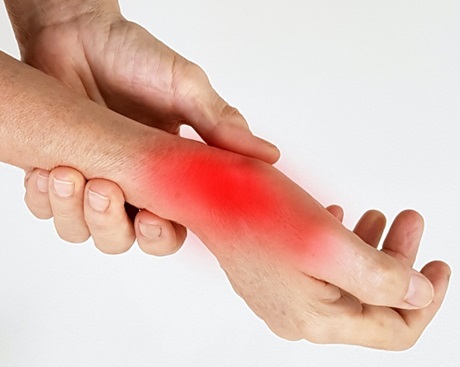
Sharp thumb-side wrist pain worsened by gripping, lifting, or turning the wrist. Common in new mothers. Highly responsive to cortisone injection.
What is De Quervain's Tenosynovitis?
De Quervain's tenosynovitis is an inflammation of the sheath surrounding the abductor pollicis longus (APL) and extensor pollicis brevis (EPB) tendons as they pass through the first dorsal compartment of the wrist. This causes pain, swelling, and tenderness at the base of the thumb on the radial side of the wrist.
It is particularly common in new mothers (related to lifting and carrying a baby with the wrist extended), women aged 30–50, and those with repetitive gripping and pinching occupations. The positive Finkelstein test — ulnar deviation of the wrist with the thumb tucked inside the fist — reproduces sharp pain and is diagnostic.
Symptoms
Symptoms
Sharp pain on the thumb side of the wrist
Tenderness directly over the radial styloid process
Swelling over the first dorsal compartment
Pain worsened by gripping, pinching, turning a key, or lifting
Positive Finkelstein test
Occasional catching or snapping with thumb movement
How it is diagnosed
Clinical examination — Finkelstein test is diagnostic
Ultrasound to assess tendon sheath thickening and guide injection
Assessment for associated de Quervain's variant anatomy
X-ray to exclude CMC arthritis if thumb pain is prominent
Non-surgical Treatment
Non-surgical options
Thumb spica splinting — immobilises the thumb and wrist
Corticosteroid injection — highly effective in 60–80% of cases
Activity modification — avoid repetitive pinch and lifting
Physiotherapy for ergonomic advice and strengthening
When to consider surgery
Surgical first dorsal compartment release is recommended when cortisone injection fails or symptoms recur. A small incision releases the tight sheath over the APL and EPB tendons. The procedure takes approximately 15 minutes under local anaesthetic and provides reliable long-term relief. Anatomical variants (septa within the compartment) are addressed at the time of surgery.
Typical recoveryInjection: resolution within 1–2 weeks in most cases. Surgery: light activities within 3–5 days, return to work 2–3 weeks, full recovery 4–6 weeks. Results are excellent in over 90% of surgical cases.
When to see a Hand Surgeon
Seek specialist assessment if:Pain not responding to 4–6 weeks of splinting. Symptoms returning after one or two cortisone injections. Inability to care for a baby or infant due to wrist pain. Snapping or locking of the tendon with thumb movement.
Frequently asked questions
Common questions about de quervain's tenosynovitis, answered by Dr David Ma.
Mild cases may improve with splinting and activity modification, particularly if the cause (e.g., lifting a baby) is temporary. Persistent or severe cases are best treated with cortisone injection, which resolves symptoms in 60–80% of patients.
Cortisone injection is safe and effective for de Quervain's tenosynovitis. Side effects are uncommon but include temporary skin depigmentation or thinning at the injection site. Ultrasound guidance improves accuracy and reduces this risk.
This can be performed under local anaesthetic without general anaesthesia, which makes it compatible with breastfeeding. Please discuss with Dr Ma and your obstetrician.
Both cause thumb-side wrist pain, but they are distinct conditions. De Quervain's is more localised to the radial styloid and is aggravated by the Finkelstein test. CMC arthritis causes pain lower at the base of the thumb and shows changes on X-ray. Both can coexist.
A GP referral is recommended for Medicare rebates but not required to book.
Dr David Ma treats De Quervain's tenosynovitis at accredited Sydney facilities.
Consultations at Chatswood (North Shore — Lane Cove, Willoughby, Artarmon, St Leonards, Gordon)
and Strathfield (Inner West — Burwood, Homebush, Rhodes, Concord, Auburn, Newington).
Call (02) 8112 8569 or email admin@drdavidma.com.