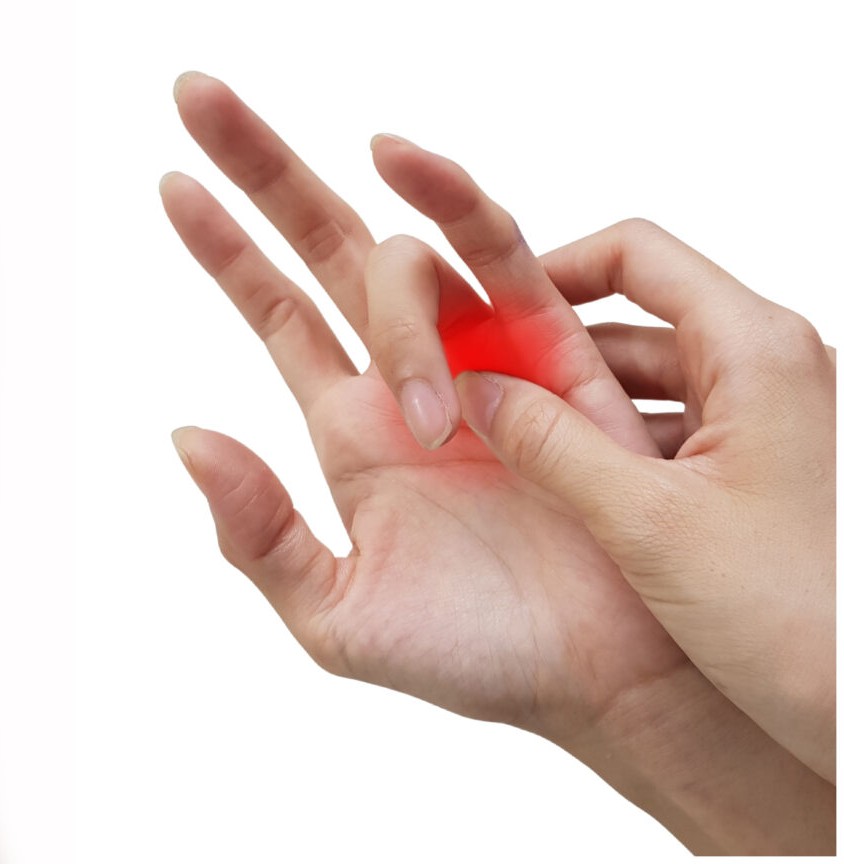
Clicking, locking, or inability to fully straighten a finger. Highly responsive to cortisone injection — simple surgical release when needed.
What is Trigger Finger?
Trigger finger (stenosing tenosynovitis) occurs when the flexor tendon catches on a narrowed A1 pulley at the base of the finger as the tendon tries to glide through. The result is clicking, locking, or an inability to fully straighten the finger.
It most commonly affects the ring finger, middle finger, or thumb (trigger thumb). It is more common in women, people over 40, and those with diabetes or rheumatoid arthritis. Multiple fingers can be affected simultaneously.
Symptoms
Symptoms
Clicking or snapping on bending and straightening
Finger locking in a bent position — requiring manual release
Tenderness over the A1 pulley at the base of the finger
Stiffness, especially in the morning
A nodule palpable at the base of the finger
In trigger thumb: a locking or clicking thumb
How it is diagnosed
Clinical examination — palpable nodule and clicking over A1 pulley
No imaging usually required
Ultrasound if diagnosis is unclear or to guide injection
Assessment for associated conditions (diabetes, rheumatoid)
Non-surgical Treatment
Non-surgical options
Corticosteroid injection into the tendon sheath — resolves 60–70% of cases
Splinting to rest the finger in extension
Activity modification to reduce repetitive gripping
Second injection considered if partial or temporary response
When to consider surgery
A1 pulley release under local anaesthetic is a highly effective 10-minute procedure when injection has failed or the trigger is severe. A small incision in the palm releases the tight pulley, allowing the tendon to glide freely. Finger movement is restored immediately.
10-minute procedureLocal anaestheticDay surgeryImmediate movement restored
Recovery Expectations
Typical recoveryInjection: resolution within 1–2 weeks. Surgery: return to light activities within 2–3 days, full recovery 3–4 weeks. Immediate restoration of smooth finger movement after release.
When to see a Hand Surgeon
Seek specialist assessment if:Finger locking in a bent position that requires manual straightening. Symptoms not responding to two cortisone injections. Trigger thumb in a child. Severe or fixed flexion contracture of the finger.
Frequently asked questions
Common questions about trigger finger, answered by Dr David Ma.
No. Cortisone injection resolves trigger finger in 60–70% of cases and is always the first treatment. Surgery is recommended if injection fails, the trigger recurs, or the finger is locked.
Trigger finger release is performed under local anaesthetic as a 10-minute procedure. Post-operative discomfort is mild and well controlled with paracetamol. Most patients do not require strong pain relief.
Finger movement is restored immediately after surgery. Most patients return to light activities within 2–3 days and full activity within 3–4 weeks.
Surgical release has a very low recurrence rate — less than 1–2%. Cortisone injection recurrence is more common (30–40% over 1–2 years).
A GP referral is recommended for Medicare rebates but not required to book.
Dr David Ma performs trigger finger release at accredited Sydney facilities.
Consultations at Chatswood (North Shore — Lane Cove, Willoughby, Artarmon, St Leonards, Gordon)
and Strathfield (Inner West — Burwood, Homebush, Rhodes, Concord, Auburn, Newington).
Call (02) 8112 8569 or email admin@drdavidma.com.