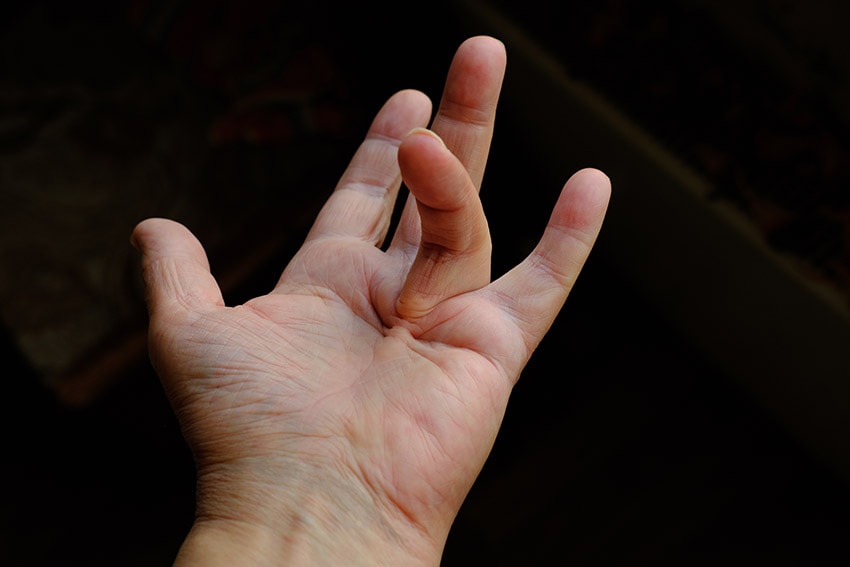
Progressive thickening of the palmar fascia drawing fingers into a bent position. Multiple treatment options from minimally invasive needle to surgical fasciectomy.
What is Dupuytren's Disease?
Dupuytren's disease is a benign fibroproliferative condition of the palmar fascia. Nodules and cords of thickened fibrous tissue form in the palm and fingers, gradually pulling one or more digits — most commonly the ring and little finger — into a flexed contracture.
The condition has a strong genetic basis and is more prevalent in men and those of Northern European descent. It is not caused by manual labour or injury. Early disease presents as nodules in the palm; advanced disease causes a fixed finger contracture limiting hand function.
Symptoms
Symptoms
Firm nodules in the palm — often the first sign
Cords running from the palm into the finger
Progressive inability to fully straighten the ring or little finger
Difficulty placing the hand flat on a table (table-top test)
The deformity worsens gradually over months to years
Pain is uncommon — contracture is the main concern
How it is diagnosed
Clinical examination — Hueston table-top test
Measurement of total passive extension deficit (TPED)
No imaging usually required
Assessment for associated conditions (diabetes, alcohol)
Non-surgical Treatment
Non-surgical options
Observation for nodule-only disease without contracture
Physiotherapy and splinting may slow early progression
Collagenase injection (Xiapex) — non-surgical option for select cord disease
Needle aponeurotomy — in-clinic procedure to divide cords
When to consider surgery
Surgical fasciectomy is recommended when the metacarpophalangeal joint contracture reaches 30° or any proximal interphalangeal joint contracture develops. It provides more durable, longer-lasting correction than needle techniques, particularly for severe or recurrent contractures.
Needle aponeurotomy optionFasciectomy for severe/recurrentHand therapy post-opRegional or general anaesthetic
Recovery Expectations
Typical recoveryNeedle aponeurotomy: return to most activities within a few days. Fasciectomy: splinting and hand therapy for 4–8 weeks, full recovery 8–12 weeks. Recurrence is possible with any treatment and is higher for needle techniques.
When to see a Hand Surgeon
Seek specialist assessment if:Any finger contracture that prevents you from fully extending a finger. Difficulty with daily tasks such as putting on gloves, washing hands, or shaking hands. Contracture progressing despite conservative management.
Frequently asked questions
Common questions about dupuytren's disease, answered by Dr David Ma.
Treatment depends on the severity of the contracture and the patient's overall health. Surgical fasciectomy removes the diseased cord and provides durable correction for moderate to severe contractures. Dr Ma will discuss the most appropriate option and its trade-offs at your consultation.
Recurrence is possible after surgery. Recurrence risk is higher in those with aggressive disease, bilateral involvement, or a strong family history. Regular follow-up helps detect early recurrence.
Fasciectomy is performed under regional or general anaesthetic. Post-operative discomfort is managed with standard pain relief. A drain is sometimes used overnight. Hand therapy begins within days of surgery.
Yes. Dupuytren's disease has a strong genetic component. If multiple family members are affected, you are at higher risk of developing more aggressive disease.
A GP referral is recommended for Medicare rebates but not required to book.
Dr David Ma treats Dupuytren's disease at accredited Sydney facilities.
Consultations at Chatswood (North Shore — Lane Cove, Willoughby, Artarmon, St Leonards, Gordon)
and Strathfield (Inner West — Burwood, Homebush, Rhodes, Concord, Auburn, Newington).
Call (02) 8112 8569 or email admin@drdavidma.com.