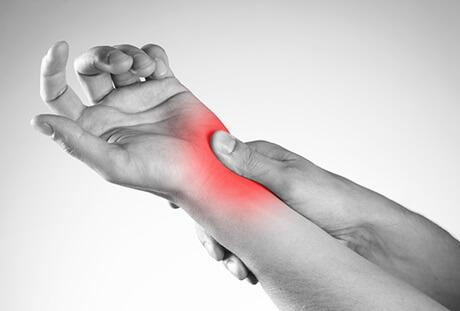
The most common cause of ulnar-sided wrist pain — frequently missed on MRI. Wrist arthroscopy is the gold standard for diagnosis and repair.
What is TFCC Injuries?
The triangular fibrocartilage complex (TFCC) is the main cartilage and ligament structure on the little-finger (ulnar) side of the wrist. It cushions the wrist joint, stabilises the distal radioulnar joint (DRUJ), and transmits load from the hand to the forearm. TFCC tears are classified by Palmer's system into traumatic (Type 1) and degenerative (Type 2) lesions.
TFCC tears are the most common cause of ulnar-sided wrist pain and are frequently missed — patients often experience months or years of aching, clicking, or giving way after a fall or twisting injury, labelled simply as a sprain. MRI can suggest the diagnosis but wrist arthroscopy remains the definitive standard for diagnosis and surgical repair. This is an area of advanced subspecialty expertise for Dr Ma.
Symptoms
Symptoms
Aching or sharp pain on the ulnar (little-finger) side of the wrist
Pain worsened by gripping, twisting, or weight-bearing through the wrist
Clicking or clunking with forearm rotation
Giving way or instability of the wrist
Tenderness directly over the TFCC (ulnar fovea sign)
Swelling persisting after a wrist sprain or fall
How it is diagnosed
Clinical examination — fovea sign, DRUJ stress test
MRI wrist — useful but sensitivity for TFCC tears is 70–80%
CT arthrogram — higher sensitivity than standard MRI
Wrist arthroscopy — gold standard for definitive diagnosis and repair
Non-surgical Treatment
Non-surgical options
Immobilisation in a long-arm cast or brace for 4–6 weeks
Activity modification to avoid forearm rotation and gripping
Corticosteroid injection for degenerative (Type 2) tears
Physiotherapy for DRUJ stabilisation exercises
When to consider surgery
Arthroscopic TFCC repair is indicated for acute traumatic tears in active patients who have failed conservative management. Dr Ma performs arthroscopic-assisted TFCC repair through small wrist portals, restoring the foveal attachment of the TFCC to the ulna. DRUJ stabilisation and associated procedures are performed in the same setting when required.
Advanced wrist arthroscopyTFCC repairDRUJ stabilisationDay surgery
Recovery Expectations
Typical recoveryAfter arthroscopic TFCC repair: long-arm splint for 4–6 weeks, then hand therapy. Return to desk work at 6–8 weeks. Return to manual work or sport at 3–6 months. Full recovery typically 4–6 months.
When to see a Hand Surgeon
Seek specialist assessment if:Persistent ulnar wrist pain more than 6 weeks after a wrist injury. Clicking or giving way of the wrist. Diagnosis of TFCC tear on MRI or CT arthrogram. Wrist pain not responding to splinting and activity modification.
Frequently asked questions
Common questions about tfcc injuries, answered by Dr David Ma.
TFCC tears are frequently labelled as "wrist sprains" because they do not show on standard X-rays and MRI sensitivity is only 70–80%. A negative MRI does not exclude a significant TFCC tear. Wrist arthroscopy is the only way to definitively diagnose and repair the injury.
Not always. Degenerative (Type 2) tears in older patients often respond to cortisone injection, activity modification, and physiotherapy. Acute traumatic tears in young, active patients with instability or ongoing symptoms are best treated surgically for the most reliable recovery.
The wrist is splinted for 4–6 weeks after repair. Supervised hand therapy follows for a further 6–8 weeks. Most patients return to desk work at 6–8 weeks and full activity at 3–6 months.
The distal radioulnar joint (DRUJ) is the joint between the radius and ulna at the wrist. TFCC tears often cause DRUJ instability — a feeling of clicking or giving way with forearm rotation. DRUJ stabilisation can be performed at the same time as TFCC repair.
A GP referral is recommended for Medicare rebates but not required to book.
Dr David Ma performs arthroscopic TFCC repair at accredited Sydney facilities.
Consultations at Chatswood (North Shore — Lane Cove, Willoughby, Artarmon, St Leonards, Gordon)
and Strathfield (Inner West — Burwood, Homebush, Rhodes, Concord, Auburn, Newington).
Call (02) 8112 8569 or email admin@drdavidma.com.