Flexor and extensor tendon lacerations, avulsions, and ruptures — microsurgical repair and closely supervised hand therapy for optimal recovery.
What is Tendon Injuries?
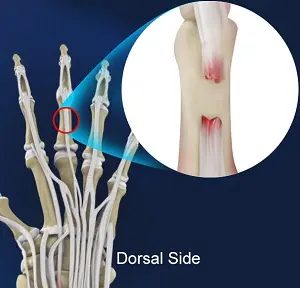
Tendons connect muscles to bones and transmit the force of muscle contraction to move the fingers and wrist. The hand has two systems: flexor tendons (palm side — bending the fingers) and extensor tendons (back of the hand — straightening the fingers). Both systems can be injured by lacerations, avulsion injuries, or spontaneous ruptures from inflammatory or degenerative disease.
Tendon injuries require urgent specialist assessment. The timing and technique of repair are critical — flexor tendon injuries in Zone 2 (the "no man's land" of the finger between the A1 and A4 pulleys) are among the most technically demanding problems in hand surgery, requiring precise repair followed by closely supervised hand therapy.
Symptoms
Symptoms
Inability to bend one or more fingers (flexor tendon injury)
Inability to straighten a finger (extensor tendon injury)
Visible wound over the finger, hand, or wrist
Pain and swelling after a cut or crush injury
Weakness of grip or inability to hold objects
Sudden loss of movement without obvious injury (spontaneous rupture)
How it is diagnosed
Clinical examination — systematic testing of each tendon in isolation
Wound assessment including depth and contamination
Ultrasound to identify partial lacerations and retracted tendons
Assessment of pulley integrity for flexor tendon injuries
Non-surgical Treatment
Non-surgical options
Wound cleaning and closure for minor lacerations not involving tendon
Splinting for partial lacerations (less than 50% of tendon width)
Anti-inflammatory medications and physiotherapy for tendonitis
Structured hand therapy programme after repair
When to consider surgery
Complete tendon lacerations require surgical repair under magnification to precisely align tendon ends. A strong core suture technique allows early active mobilisation, which is essential to prevent adhesions. Delayed repairs and reconstructions using tendon grafts are available for late presentations. Dr Ma performs all repairs using microsurgical-level technique.
Microsurgical repairTendon grafting availableEarly active mobilisationHand therapy essential
Recovery Expectations
Typical recoveryFlexor tendon repair: strict supervised hand therapy protocol for 8–12 weeks, full recovery 3–4 months. Extensor tendon: splinting 4–6 weeks, full recovery 8–12 weeks. Hand therapy is critical — compliance with the therapy programme is one of the most important factors in outcome.
When to see a Hand Surgeon
Seek specialist assessment if:Any inability to move a finger after a cut, crush, or injury. A wound over the hand or wrist that may have involved a tendon. A sudden loss of finger movement without injury. Any flexor tendon injury should be assessed within 1–2 weeks for the best chance of primary repair.
Frequently asked questions
Common questions about tendon injuries, answered by Dr David Ma.
Any tendon injury — complete or partial — warrants specialist assessment to determine whether surgical repair or splinting is appropriate. The decision depends on the extent of injury, which tendon is affected, and how it impacts finger movement. Not all tendon injuries require surgery, but early specialist review is strongly recommended before any treatment pathway is chosen.
Primary repair within 7–14 days of injury gives the best results and is technically easier. After 3–4 weeks, scar tissue makes repair harder and tendon grafting may be required. It is always worth seeking assessment even weeks after an injury.
Tendons heal by forming scar tissue, which can adhere to surrounding structures and restrict movement. A carefully supervised tendon gliding programme — beginning within days of surgery — is essential to achieve full range of motion. Poor compliance with hand therapy is the most common cause of a suboptimal outcome.
Yes. Rheumatoid arthritis, prolonged corticosteroid use, and bony erosions can cause spontaneous tendon ruptures. These are treated with tendon transfer or reconstruction.
A GP referral is recommended for Medicare rebates but not required to book.
Dr David Ma performs tendon repair and reconstruction at accredited Sydney facilities.
Consultations at Chatswood (North Shore — Lane Cove, Willoughby, Artarmon, St Leonards, Gordon)
and Strathfield (Inner West — Burwood, Homebush, Rhodes, Concord, Auburn, Newington).
Call (02) 8112 8569 or email admin@drdavidma.com.