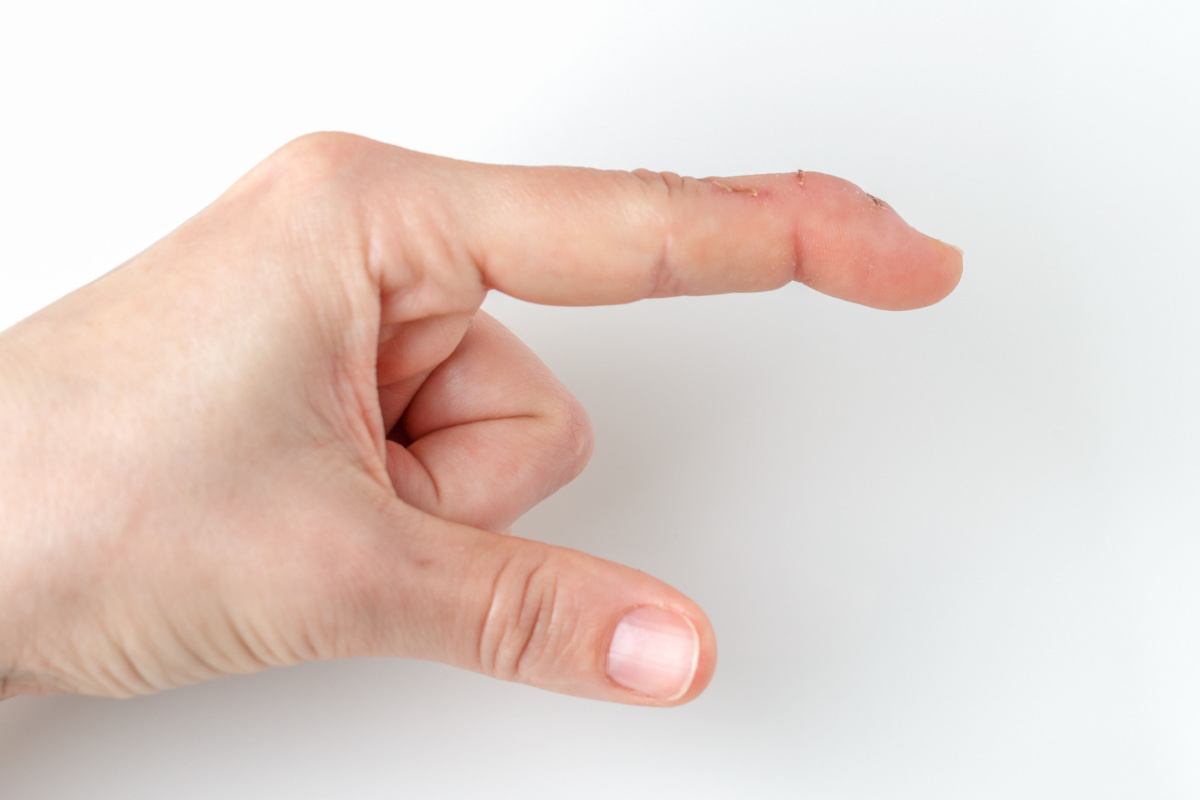
A drooping fingertip after an injury — caused by extensor tendon avulsion. Treated successfully with splinting in most cases.
What is Mallet Finger?
Mallet finger is an injury to the extensor tendon at the fingertip — either a pure tendon avulsion (soft tissue mallet) or a fracture where a bone fragment is pulled away (bony mallet). The result is an inability to actively straighten the end joint of the finger (DIP joint), which droops at rest.
It most commonly results from a ball striking the tip of a finger. The ring, middle, and little fingers are most often affected. Most soft tissue mallets are successfully treated with continuous extension splinting for 6–8 weeks. Surgical fixation is reserved for bony mallets involving a large joint fragment with joint subluxation.
Symptoms
Symptoms
Bent fingertip — inability to actively straighten the end joint
Pain and swelling at the back of the fingertip after injury
Bruising over the dorsal DIP joint
Late-presenting mallet — a chronic droop without acute pain
In bony mallet: tenderness over the dorsal base of the fingertip
Swan neck deformity may develop in neglected cases
How it is diagnosed
Clinical examination — inability to extend DIP joint against resistance
X-ray of the finger — to identify bony fragment and any joint subluxation
Assessment of fragment size relative to joint surface
Late presentations may need MRI or CT if bony fragment is uncertain
Non-surgical Treatment
Non-surgical options
Extension splinting of the DIP joint — continuous wear for 6–8 weeks
Custom thermoplastic or commercial stack splint
Splint must be worn continuously — even one moment of flexion resets healing
Followed by 4–6 weeks of part-time splinting for protection
When to consider surgery
Surgery is indicated for bony mallets with more than one-third of the joint surface involved and volar subluxation of the distal phalanx, or for patients failing conservative treatment. Extension block K-wire pinning or open screw fixation restores joint congruence and prevents late arthritis.
Splinting first-lineSurgery for bony mallet/subluxationDay surgeryK-wire fixation
Recovery Expectations
Typical recoverySoft tissue mallet with splinting: 6–8 weeks full-time splinting, 4–6 weeks part-time. Small residual droop (5–10°) is common and usually functional. Surgical cases: protected mobilisation after hardware removal at 4–6 weeks.
When to see a Hand Surgeon
Seek specialist assessment if:Any fingertip that droops and cannot be actively straightened after an injury. Bony mallet on X-ray with a large fragment. A mallet injury not improving after 3–4 weeks of splinting. Chronic untreated mallet with developing deformity.
Frequently asked questions
Common questions about mallet finger, answered by Dr David Ma.
No. The majority of mallet fingers — including most soft tissue avulsions — are successfully treated with continuous extension splinting for 6–8 weeks. Surgery is reserved for specific bony mallets or failed conservative management.
Extremely important. The tendon must be held in extension throughout the entire healing period. Even a single moment of DIP flexion resets the healing clock. The splint can be changed while keeping the fingertip extended — never allow it to bend.
Swan neck deformity develops in neglected mallet fingers. The middle joint hyperextends while the fingertip droops, creating an S-shaped deformity. It can also develop from prolonged untreated mallet. Reconstruction is complex — prevention by early splinting is much better.
Most patients achieve a functional result with splinting. A small residual droop of 5–10° is common and rarely affects function. Surgical fixation of bony mallets aims for functional correction, though a small residual limitation is possible.
A GP referral is recommended for Medicare rebates but not required to book.
Dr David Ma treats mallet finger at accredited Sydney facilities.
Consultations at Chatswood (North Shore — Lane Cove, Willoughby, Artarmon, St Leonards, Gordon)
and Strathfield (Inner West — Burwood, Homebush, Rhodes, Concord, Auburn, Newington).
Call (02) 8112 8569 or email admin@drdavidma.com.