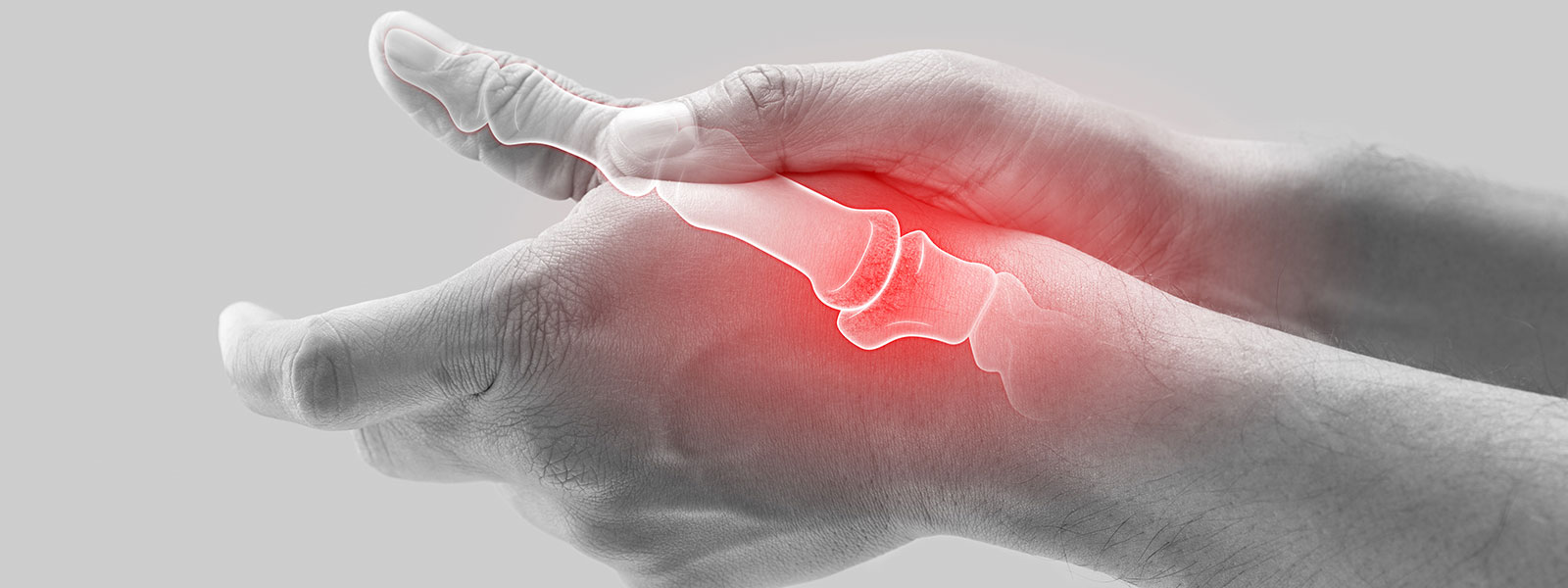
Arthritis at the base of the thumb — pain, weakness, and deformity with pinching and gripping. Highly treatable with injections and surgical reconstruction.
What is Thumb Arthritis?
Thumb carpometacarpal (CMC) arthritis is the most common form of hand arthritis in adults, particularly women over 50. It affects the basal joint at the base of the thumb where it meets the wrist, causing pain, weakness, and progressive deformity with pinching and gripping activities.
As the cartilage wears away, the joint becomes unstable and painful. Advanced disease can lead to a characteristic dorsal subluxation of the metacarpal base and hyperextension of the thumb MCP joint (Z-deformity). Even advanced disease responds well to surgical treatment.
Symptoms
Symptoms
Pain at the base of the thumb — worse with pinching, gripping, or opening jars
Swelling and tenderness over the CMC joint
Weakness of pinch and grip strength
A grinding sensation with thumb movement
Visible enlargement of the joint in advanced disease
Loss of thumb opposition and web space narrowing
How it is diagnosed
Clinical examination — grind test and stress test
X-ray showing joint space narrowing, osteophytes, and subluxation
Eaton-Littler classification of severity on X-ray
Ultrasound-guided injection as both diagnostic and therapeutic tool
Non-surgical Treatment
Non-surgical options
Thumb spica splinting — activity-related and at night
Corticosteroid injection under ultrasound guidance
Activity modification — avoiding pinch and grip-heavy activities
Hand therapy for muscle strengthening and splint fitting
When to consider surgery
Trapeziectomy (surgical removal of the trapezium bone) reliably relieves pain and restores function. A ligament reconstruction using a slip of tendon stabilises the thumb. The results are durable and long-lasting. Partial trapeziectomy and CMC joint replacement are alternatives in selected patients. For patients interested in a bone-preserving joint replacement option, Thumb CMC Replacement is discussed in detail on a dedicated page.
TrapeziectomyLigament reconstructionDay surgeryRegional or general anaesthetic
Recovery Expectations
Typical recoveryThumb spica splinting for 4–6 weeks after surgery. Hand therapy for 8–12 weeks. Return to light activities at 6–8 weeks. Full function at 3–6 months. Long-lasting pain relief in over 90% of patients.
When to see a Hand Surgeon
Seek specialist assessment if:Pain at the base of the thumb limiting daily activities such as writing, cooking, or opening bottles. Failure to improve with splinting and one or two cortisone injections. Any deformity or instability of the thumb. Significant pain on X-ray.
Frequently asked questions
Common questions about thumb arthritis, answered by Dr David Ma.
Trapeziectomy has excellent long-term outcomes — over 90% of patients have significant pain relief and improved function. The results are durable with low revision rates over 10–20 years.
The thumb is splinted for 4–6 weeks, followed by 8–12 weeks of hand therapy. Most patients return to light activities at 6–8 weeks and full function by 3–6 months. Heavy pinch activities take the longest to recover.
Cortisone injections provide significant temporary relief in most patients and can delay the need for surgery by months to years. They are most effective in early to moderate disease.
Trapeziectomy removes the arthritic trapezium bone and is the most established procedure with excellent long-term outcomes. CMC joint replacement preserves the bone but has less data on durability. Dr Ma discusses the best option based on your age, activity level, and X-ray findings.
A GP referral is recommended for Medicare rebates but not required to book.
Dr David Ma treats thumb and hand arthritis at accredited Sydney facilities.
Consultations at Chatswood (North Shore — Lane Cove, Willoughby, Artarmon, St Leonards, Gordon)
and Strathfield (Inner West — Burwood, Homebush, Rhodes, Concord, Auburn, Newington).
Call (02) 8112 8569 or email admin@drdavidma.com.